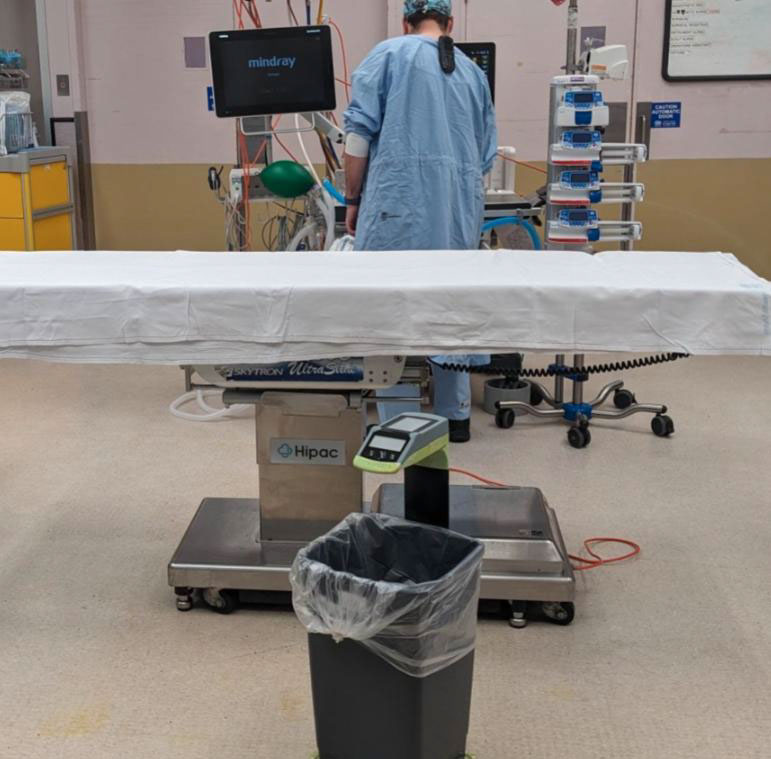
SureWaste units were deployed in active operating theatres at a major NSW hospital to evaluate the effectiveness of the SureWaste system in identifying and quantifying unused consumables. The study aimed to provide actionable insights into how to save money and reduce waste across health facilities.
Objectives
- Demonstrate the feasibility of using SureWaste to automatically record unused consumables disposed of during surgical procedures.
- Quantify the financial impact of unused
Approach
SureWaste was installed and supervised by a qualified medical engineer during the study. The capture quality and sample rate was monitored to confirm that the data accurately represented the actual waste material. Procedures were selected at random taking into account patient risk levels and staff availability. The study focused on orthopaedic, cardiothoracic, neurological, and general abdominal surgeries.
The SureWaste system captured images at 10-minute intervals. The system used Al-powered waste identification and integrated scales to measure item weight and type, enabling precise tracking of unused materials.
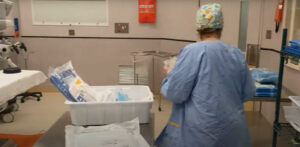
For the study the SureWaste bin assembly was positioned in the operating theatre behind the scout nurse near the general theatre waste bin. SureWaste is designed however to be adapted to any existing bin system in service.
Results
Each 2-hour surgery typically resulted in $20-$40 worth of unused consumables
being discarded, and often the same items across multiple surgeries. For each unused item, the procurement cost was determined7 and combined with the disposal rate measured by SureWaste. This data was verified manually by the supporting engineers for this study (once verified the system is completely automated).
Extrapolated across the 340,000 annual public NSW hospital operations, and a similar number conducted in private hospitals, there is the potential for large savings both in cost and environmental impact.
Estimated savings example
| Item | Estimated Item Cost ($)1 | Cases per year issued with item2 | Rate of disposal unused (%)3 | Annual Value of wasted items ($)4 |
| Disposable instrument | $5.50 | 26208 | 33% | $48,048 |
| Plastic item | $2.95 | 52416 | 67% | $103,085 |
| Sheet item | $70.00 | 21840 | 60% | $917,280 |
| TOTAL ANNUAL SAVINGS $1,068,413 |
Items of regularly unused waste ranged from non-returnable unused surgical kit items to partially consumed items and out-of-life stock. These cost estimates do not include transport, disposal, and labour costs associated with disposal of the unused items.
Additional insights from the NSW Health Annual Report and Advitech’s financial modelling suggest that:
$2.3 billion is spent annually on consumables and pharmaceuticals (2023FY)
$165 million worth of stock is written off unused annually due to expiry or damage alone (2023FY).
Problem Complexity and the Need for Scale
Reducing waste in operating theatres can be a complex challenge. Standard surgical kits, for example, are often shared across multiple facilities and specialties. Removing an item from one kit may inadvertently affect workflows or safety in another context.
SureWaste solves this by providing ongoing, robust, statistical data of what the true usefulness of any consumable is across multiple departments and facilities. SureWaste could identify exactly what items are disposed of unused in what procedure, at which facility, and by different staff. SureWaste can then clearly and simply present an overview of the items usefulness over a period. This empowers decision makers and procurement teams to make kit or stock allocation changes with confidence of exactly what the benefit and impact will be.
Only through automated data collection and widespread deployment at scale can healthcare providers develop actionable insights on cost savings without unforeseen consequence or compromising clinical safety.
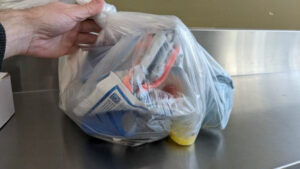
Unused items disposed of during a single procedure captured in the trial. While in certain circumstances items are permitted to return to theatre stocks, conformance with standard surgical infection control practices dictate the disposal of unused items.
Conclusion
The SureWaste system provides a scalable, automated solution for tracking unused surgical consumables. It enables:
- Tens of millions of dollars in cost savings by providing feedback to procurement teams and decision makers,
- Reduced emissions and environmental impact through a reduction in unnecessary stock purchases,
- Significant cost reductions from improved waste stream separation and disposal efficiency,
- Enhanced audit capabilities with lower cost and higher accuracy.
Ready to partner?
We’re looking for healthcare providers ready to lead the way in sustainable, data driven waste management.
Talk to our team: mail@novecom.com.au | novecom.com.au
Footnotes
1 SureWaste was not provided the actual procurement costs for items studied so the value of the unused items collected for each procedure was estimated based on publicly available supplier pricing or estimated based on a similar product. For a commercial deployment SureWaste is built on a software architecture that can interface directly with stock management systems to extract actual cost data.
2 Extrapolated from the rate of disposal measured during the trial period multiplied by the total annual number of procedures completed in the health district studied. The result calculated over the state or country will be significantly higher than this.
3 Measured during the trial.
4 Total for the health district studied calculated from the data presented in the table.