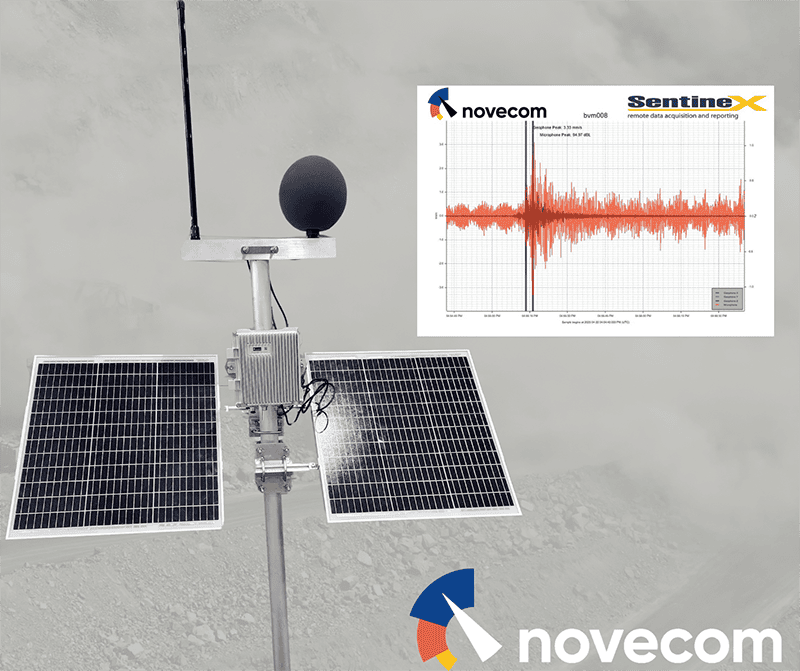
Equipment
8 blast vibration monitors
Deployed
December 2022, expanded since
Regulatory
Environmental authority conditions, AS 2187.2-2006 Appendix J
Outcome
Continuous sampling at 1,000 times per second
The operation
Blast monitoring on a Queensland coal operation is a continuous obligation, not a periodic one. Conditions set in the site’s environmental authority define the airblast overpressure and ground vibration limits that apply, and every blast must be recorded and retained for at least five years.
A Queensland coal operation faced that obligation alongside a longer-term risk. As the pit advances, blasting will eventually occur within roughly 200 m of critical electricity transmission infrastructure at its closest point.
Rather than wait, the operator worked with Novecom to establish continuous blast vibration monitoring in December 2022, years ahead of the pit reaching the transmission corridor. Eight monitors have recorded ground vibration and air overpressure across the site since.
The challenge, capturing a defensible record across an advancing pit
Three conditions shaped the design of the monitoring program.
How a phased deployment established a continuous blast record
The program was structured across four phases and has remained in operation since the first units were installed.
Phase 1
Assessed monitoring requirements against the site’s environmental authority conditions and the measurement approach set out in AS 2187.2-2006 Appendix J, and determined monitor positioning relative to the pit, the site boundary and the transmission corridor.
Phase 2
Deployed blast vibration monitors across the operation from December 2022. Each unit records ground vibration through a triple axis geophone and air overpressure through an omnidirectional microphone, sampling continuously at 1,000 times per second.
Phase 3
Integrated the monitors with the mine’s communications environment. Novecom designed a hybrid backhaul combining carrier networks with the mine’s internal IT and OT systems. Acubis, the remote communications specialists within Emergent Group, worked alongside Novecom on the network integration and the off-grid power requirements at each monitoring position.
Phase 4
Moved the program into ongoing operation. Novecom continues to provide periodic servicing, calibration, troubleshooting, and data management and reporting support. Further monitors and positioning changes have been added since the initial deployment as mining progressed to the northeast.
Outcomes
What does continuous blast vibration monitoring actually give an operator?
For a blast engineer asking the question: Did this blast comply? Answering it is often a lot more complicated than it needs to be. Monitors positioned ahead of the blast, someone travelling to place them, data retrieved afterwards, results transcribed into the site’s compliance archive. That cycle can repeat for every blast, for as long as the operation continues blasting.
Permanently installed monitoring can effectively remove the cycle rather than shortening it. The monitors are already in position and already sampling, so no one mobilises to set up before a shot or returns to collect data after one. Measured results can move from the monitor to the reporting system without a manual step in between.
Two things follow from that. The first is consistency. A blast brought forward, added late or moved to a different part of the pit is captured the same way as a planned one, because nothing had to be positioned in advance for it. The second is durability of the record. Queensland requires blast records to be kept for at least five years. A record assembled by hand depends on the person who assembled it. A record captured automatically does not.
What the monitors provide is the measured part of that record: the airblast overpressure, the peak particle velocity, and the date and time of each recording. Those measured fields can often be the ones most exposed to transcription error, and the ones a regulator is most likely to test.
Reach out to the team for blast vibration monitoring
Novecom designs, manufactures and maintains blast vibration monitoring equipment in Newcastle, and supports mine sites across the east coast.
Get in touch to discuss blast vibration monitoring for your operation.